Scaling Delivery Decisions Without Slowing Down
Growth is supposed to be good news. But for platforms that make real-time operational decisions, growth can quietly become a liability. When every new order, every new driver, and every new city adds to an already strained system, the question stops being "can we handle more volume?" and starts being "can we handle more volume well enough to matter?"
That tension sits at the heart of dispatch engineering. A delivery assignment that arrives too late is no better than a wrong one. Speed and quality are not separate goals to trade off against each other; they are joint requirements. Getting the architecture wrong means failing both simultaneously.
When Complexity Grows Faster Than Volume
The instinct at most engineering organisations is to scale by adding servers. It works brilliantly for stateless workloads, where each request is independent and any machine can handle any task. Unfortunately, dispatch decisions are not like that.
Imagine a logistics platform serving a dense urban area at peak hour. Dozens of drivers are moving. Hundreds of orders are live. Some orders could share a single trip; some drivers are almost perfectly positioned for a cluster of pickups. The combinatorial space of possible assignments is enormous, and it grows faster than the number of inputs. Doubling the number of orders and drivers does not double the calculation; it can quadruple it or worse.
This is the nature of quadratic complexity, a property where the work required scales with the square of the input size rather than the input size itself. At low volumes it is barely noticeable. At high volumes it becomes the defining constraint on what a system can do. No amount of raw hardware fixes a problem that is structural.
Why Adding Machines Alone is Not Enough
Horizontal scaling, the practice of distributing work across many machines running in parallel, solves the right problem only when the work can be cleanly separated. For dispatch, that separation is awkward.
Two orders that could be batched into a single delivery trip are related. If separate machines evaluate them independently, neither machine can discover the batching opportunity. Worse, two machines might independently identify the same driver as the best available option, creating a conflict that requires expensive resolution after the fact. The savings from parallelism get eaten by the coordination overhead introduced to manage it.
There is a more subtle trap here too. Even when you distribute the heavy computation, something must still prepare the work, route each job to the right machine, collect the results, and assemble a coherent final decision. If that coordinating component is not designed to scale independently, it simply becomes the new bottleneck. You have relocated the problem rather than solved it.
The Structural Move That Changes Everything
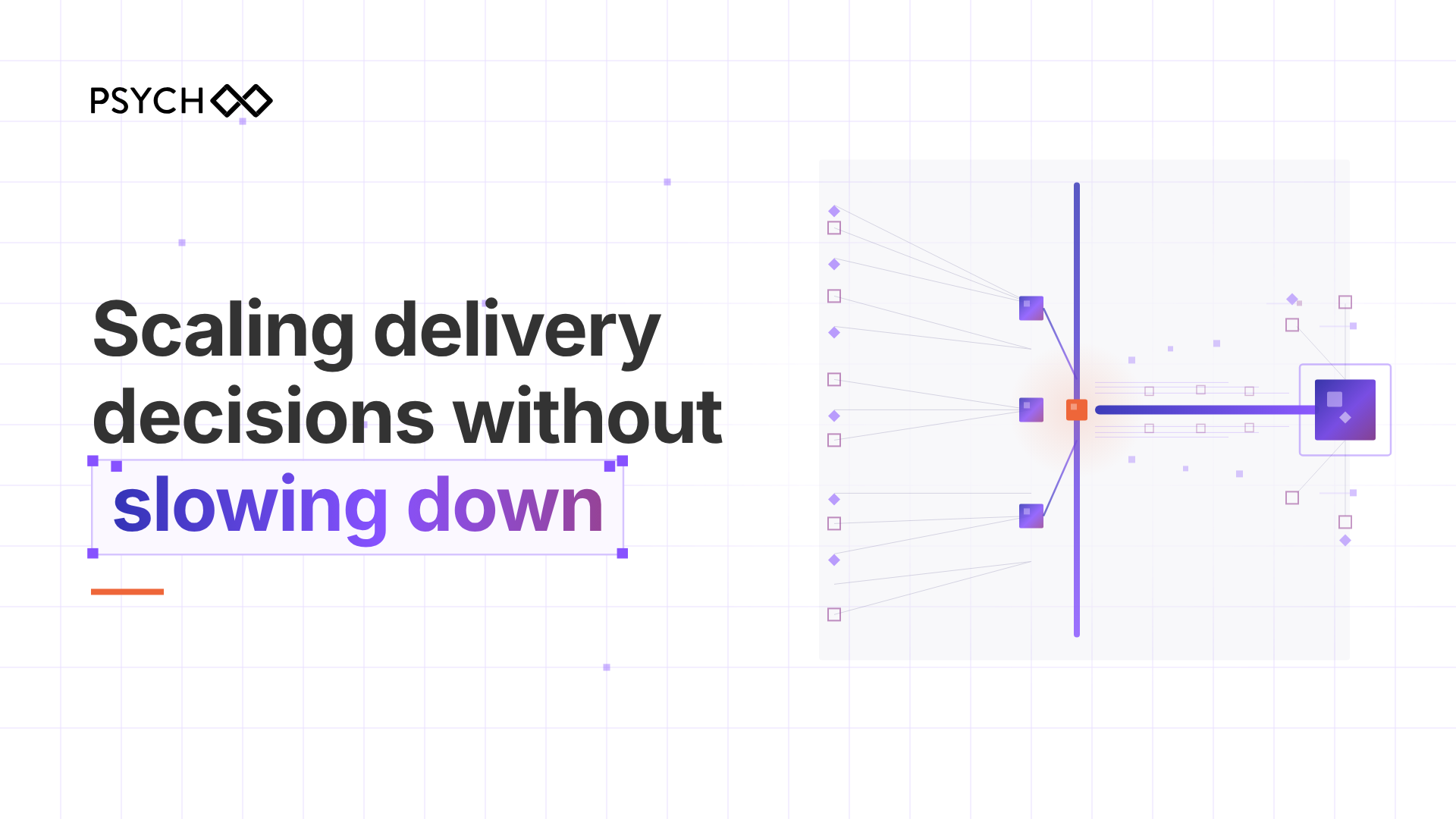
The more durable solution is architectural: separate the work of coordinating a decision from the work of computing the components of that decision. These two activities have very different scaling characteristics, and conflating them in a single process forces both to scale at the worst rate.
A coordination tier manages state, that is, the live picture of where drivers are, which orders are open, and what constraints apply. It applies business rules and organises the work that needs to happen. A compute tier executes the expensive calculations: candidate route generation, optimisation routines, and machine learning inference. Each tier can be scaled to match its own demand profile.
The practical mechanism that makes this viable is payload sharding. Rather than giving every compute worker a full copy of all logistics state (which would make data transfer itself a bottleneck), the coordinator packages only the local context each worker needs for its assigned calculation. Workers remain stateless in the meaningful sense: they receive what they need, do their work, and return results. The responsibility for the overall picture stays in one place.
Breaking the Problem Down Without Losing the Whole Picture
Separating tiers enables parallelism. But the optimisation problem itself still needs to be decomposed, or each worker simply inherits the full complexity of the original.
The approach here is hierarchical decomposition, breaking a large problem into a set of smaller, geographically coherent sub-problems. Think of it as clustering nearby orders and drivers into regional groups, then assigning each group to a different worker. Within each group, the number of possible combinations is far more manageable. Workers run simultaneously, each solving its local piece.
The challenge is that geographic boundaries are artificial. An order just inside one cluster boundary might be nearly as relevant to a driver just outside it. To account for this, results from all workers pass through a global reconciliation layer before final assignments are made. This layer considers how local solutions fit together and adjusts where needed. The result is that decision quality stays high even though the expensive computation was fragmented across many parallel workers.
What a Leader Should Take Away From This
The engineering detail matters less than the underlying principle: architectural structure determines what a system can become, not just what it can do today. A monolithic system that manages coordination and computation together will always hit a ceiling. That ceiling tends to arrive at exactly the wrong moment, during peak load, during a product launch, or during the kind of traffic spike that is good for the business but terrible for a fragile platform.
For technology leaders evaluating their own platforms, a few diagnostic questions are worth raising with engineering teams:
- When peak load increases by a factor of three or four, does our system degrade gracefully or does it start making worse decisions?
- Is our bottleneck the computation itself, or is it the coordination layer that sits above it?
- Can we scale compute capacity independently of coordination capacity, or are they coupled in ways that require touching both at once?
- Do we have shadow testing infrastructure that lets us validate a new approach against live production traffic before committing to it?
The last point deserves emphasis. Replacing a critical operational system is inherently risky. Running a new system in shadow mode, where it processes real inputs and records what it would have decided, allows behavioural comparison under genuine production conditions. Controlled switchback experiments, where old and new systems take turns handling real traffic, add further confidence before a full rollout. These are not optional safeguards; they are the difference between a smooth transition and a costly incident.
The platforms that sustain quality under growth are not the ones with the most powerful hardware. They are the ones whose architecture was designed with scaling in mind from the start, and whose teams know how to change the foundation without destabilising what sits on top of it.
If your platform is approaching the ceiling where growth starts to degrade decision quality, that is the right moment to rethink the structure, not after a peak-season failure. Psych X86 is happy to work through that assessment with you.